HeartTold · Co-founder · Conversational AI product
An AI interviewer that keeps a family's stories, and lets you ask them questions later.
1. Outcome
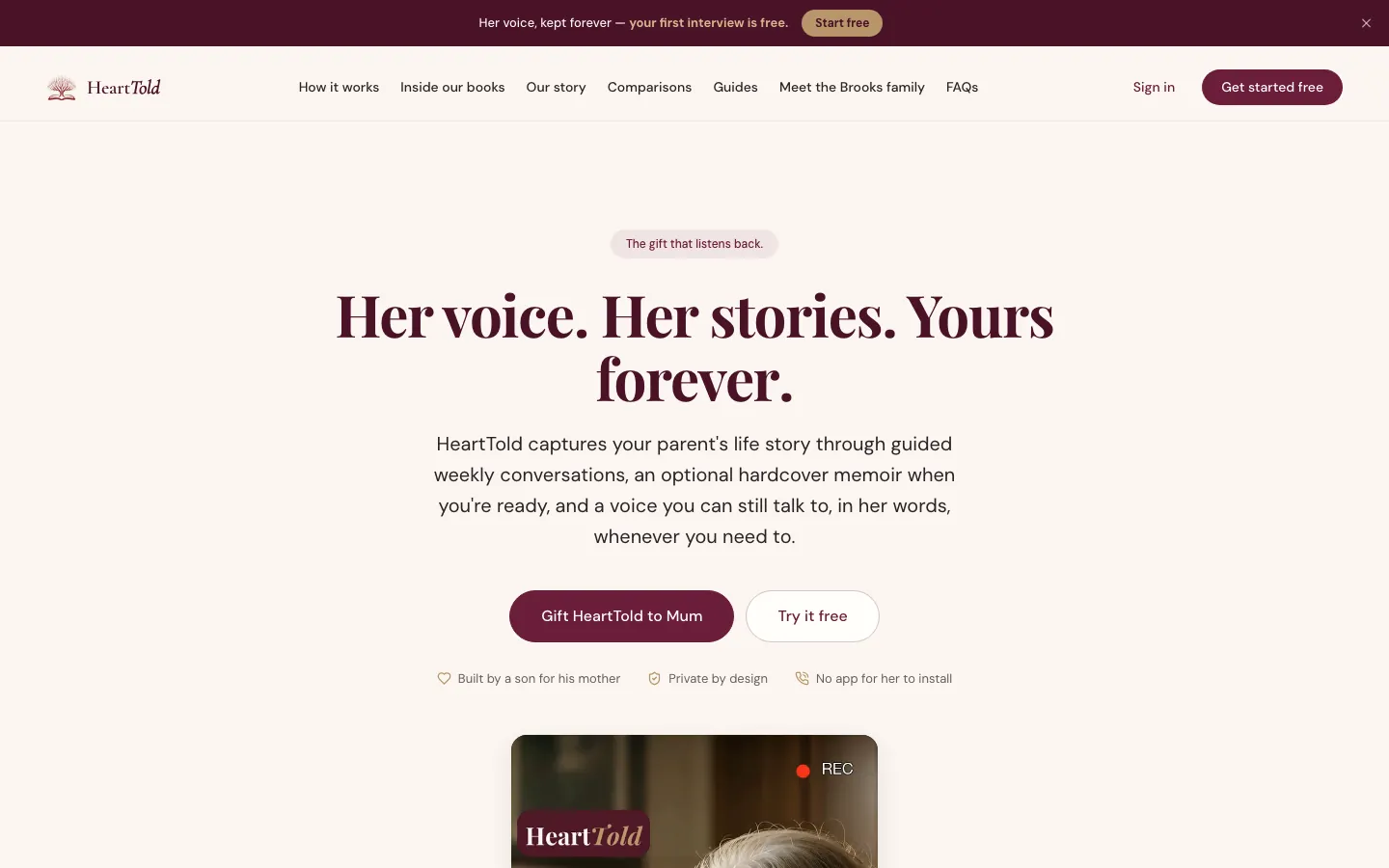
HeartTold interviews people by phone or in the browser, at times that suit them, and asks follow-up questions from what they've already said. Their stories become a searchable family archive you can talk to. Ask a question and it answers in their own words. Ask something they never covered, like "I've got a big interview on Monday, what would you tell me?", and it gives the answer they'd most likely give, clearly marked as inferred.
2. The problem
Family stories are lost when the storyteller dies. Memoir kits ask older people to write, when most would rather talk, and many aren't comfortable with technology. Once someone is gone, there's no way left to ask them anything.
3. My responsibility
Co-founder. I've spent more than 1,000 hours on the product: strategy, the interview workflow, the experience for older users and the build, which I direct with Claude Code.
4. Before and after
Before
- Stories live in a few people's memories
- Memoir kits ask older people to write
- Most stories are never recorded
After
- AI phones the storyteller, or they talk in the browser
- Each question builds on what they've already said
- A family archive you can search and ask questions
5. What was built
- Phone interviews in a natural voice, booked for times that suit the storyteller, so a grandparent only has to answer an ordinary call. Browser interviews for anyone who'd rather type or talk on screen.
- Follow-up questions written live from what the person has already said.
- Ask the archive a question and get the answer in the person's own words, marked as a quote.
- Ask something they never talked about and get their most likely answer, inferred from everything they've said and labelled as inferred. It unlocks once there's enough material to draw on.
- A family tree built from the people mentioned in the interviews, and from old documents.
- Family and friends can each be interviewed about the same person, so one life is told from several sides.
- A memoir in three styles: as told, lightly proofread, or written up, and printed as a book.
6. AI and controls
- AI: Claude writes the follow-up questions and the memoir. Vapi and ElevenLabs run the phone interviews. Whisper transcribes. GPT-4o vision reads documents.
- Retrieval uses embeddings with full-text search, so answers come from what the person actually said.
- Inferred answers are always labelled, and the model is told to hedge and never invent facts or events.
- Deterministic code handles accounts, scheduling, payments and storage.
7. Evidence
- 1,000+ h
of my own time on the product
Source: my own estimate, Oct 2026
- 674
commits from March to September 2026, 575 of them mine
Source: git history, 1 Oct 2026
- 284
automated back-end tests
Source: test suite, 1 Oct 2026
8. Technical implementation
Next.js, TypeScript, Supabase, FastAPI, Railway, Vercel, Stripe, Vapi, ElevenLabs, Whisper, Claude, GPT-4o vision